
I was spending time with my family in a beautiful park in West Bengal. Whenever I have free time, I make it a habit to go for a walk to ponder philosophy and art. On that particular day, after a long, exhausting walk, I sat down on a bench to catch my breath. As I rested, my eyes fell upon a group of children enthusiastically playing a game of chain tag.
I watched them closely, intrigued by their boundless energy. One child stood counting while the others scattered to find their positions. As soon as the countdown ended, he dashed toward them. He quickly caught a young girl, barely seven years old, took her by the hand, and together they ran after the remaining players. Whoever they caught joined their formation, hand-in-hand. As the chain grew longer, manoeuvring it became increasingly difficult, yet it allowed them to sweep across the grounds. Eventually, only one player remained uncaught—an eleven-year-old boy. He ran swiftly, evading the heavy chain for a long time, but they gradually cornered him until he had nowhere left to run. Even though he technically won by being the last survivor, he still lost in the end. I wondered: how did a single, agile boy lose to such a massive, clumsy chain?
Curious, I approached the children while they were resting after the match. After about ten minutes of introducing myself and chatting about their schools, parents, and favourite things, I asked the question that was lingering in my mind: “How did you all manage to catch him at the end? He was completely free and fast, while you were bound to a massive chain.”
The children looked at one another, silently deciding who should speak. Suddenly, a little girl piped up, “If he had a wide-open space to run, we never could have caught him. So, we decided to restrict his space, gradually pushing him into a corner where he couldn’t escape.”
“Ah, I see! You guys are incredibly smart,” I exclaimed. “But let me ask you another thing. How did it feel to be part of that chain?”
The boy who had started the game as the lone catcher beamed. “I felt great the whole time because I built the chain. I was the first one; you could say I was their leader.”
However, another girl sighed, “It was so hard for me to hold onto the chain. It felt like a burden and left me completely exhausted. When I get home, I’m going to sleep like my cat.” One by one, the other children agreed, admitting that being chained together and chasing someone down was draining. Only the leader felt a sense of pride; the rest felt weighed down.
Finally, after about twenty-five minutes of talking, I posed one last question: “Where do you go, or what do you do when you are exhausted and want to feel complete freedom? A place that makes you feel unbound.”
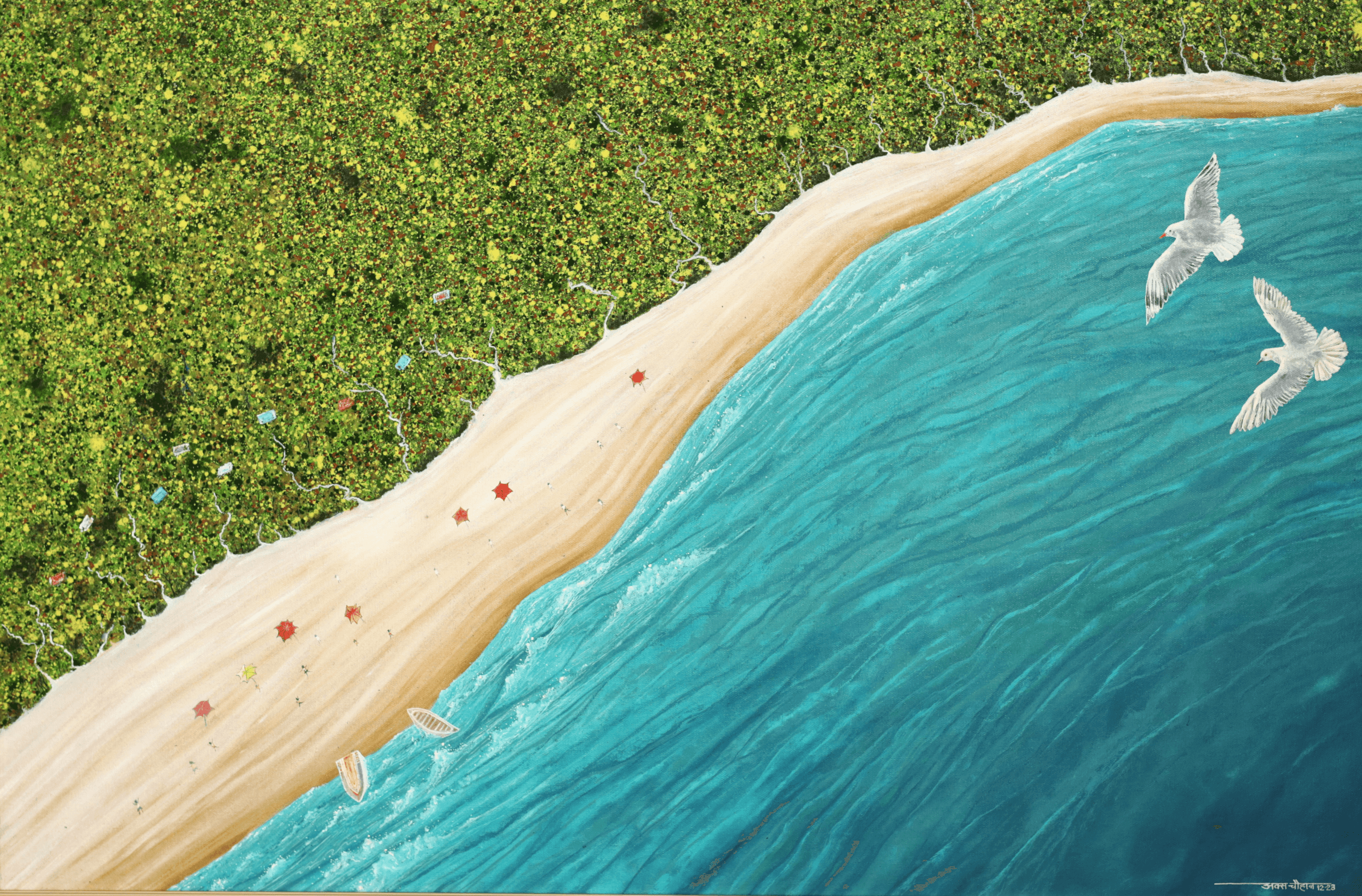
What they told me next was filled with such raw enthusiasm and fiery energy. They described their safe havens with a vivid intensity, much like an artist who sees a masterpiece clearly in their mind before touching brush to canvas. Moved by their deep emotions and vibrant imaginations, I went home and painted their vision.
I titled the painting ‘Where Seasons Touch Tides’. To me, “season” symbolises the innocence, energy, and boundless imagination of a child, while “tides” represent the chaotic, repetitive pull of our daily adult lives. It represents a place where our mundane routines can be infused with the passion and wonder of youth—a sanctuary for freedom, and a place for the resurrection of the human spirit.
Where seasons touch tides
•
Subscribe
0 Comments